In my work with scale-up leadership teams, I often hear the same frustration. “We used to move so quickly, but now everything’s so slow. It’s almost like we’ve lost what’s made us great.”
They’ll then nostalgically tell stories of better times or funny stories about particular people or incidents, but it’s always laced with a longing for perceived ‘better times’. The truth is, growing a company is hard.
When you’re 20 people, hell even 50 people, everyone can pretty much stay in the loop by being on the same calls, in the same room. But as the headcount grows, communication becomes harder. It grows again and decisions slow down. Before you know it, you feel like you’ve lost your edge and agility that made you so successful in the first place.
It’s perhaps THE most common problem I see when working with growth organisations as they scale.
I often refer to this as the “slow as you grow” trap. This is where organisational complexity grows faster than the systems designed to manage it. But why is that?
Well, first of all, communication is factorial. What does that mean? Well, whenever you add one more person it’s not just one new interaction, it’s all the communication pathways. You can see this in the graph below – it’s exponential too, so it obviously doesn’t taper off.
Companies hire more people because they want to move faster and deliver more. But without clear decision boundaries, work starts to flow upward rather than outward. What once felt like agility becomes a bottleneck.
As the graph shows, it doesn’t just feel more chaotic.
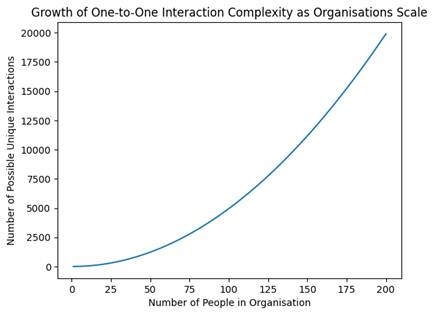
Complexity is compounding structurally.
Luckily there are a few fixes to this.
Create a system of communication
First of all, decode your communication. You’ll need to think about what does everyone need to know or be aware of and what information is only required by smaller sub-groups. Communication can often be lost in the noise as much as hidden in the dark.
Once you’ve mapped this out, think about how you keep people aligned. How do you keep people clear enough on what you’re trying to achieve to enable them to make decisions?
Then map all this out and think about how it’s going to happen in practice. In my consultancy I talk in terms of an Organisational Operating System.
The Organisational Operating System
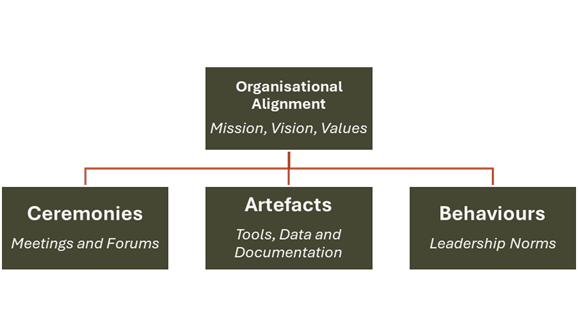
Ceremonies
What are the meetings and touch points that provide the forum for this communication. Think All Hands, Stand Ups etc.
Artifacts
What are the tools, documents and places that communicate things. Think kanban boards, memos, objectives, KPIs, emails etc.
Behaviours
What do you want people (ordinarily your leaders) to do which reinforces your communication system. Think cascading comms, bridging to other teams and proactivity.
Organisations tend to have fragments of all of the above. They do meetings, they have behaviours. But infrequently do they bring all of that together as a complete system.
Some of the most successful companies have adopted similar systems to help cope with rapid scaling. Stripe, for example, has codified its operating principles and rely heavily on written documents to communicate decisions and design thinking across the company as it scales.
Once you’ve been able to build this out explicitly, then document it (behold – another artefact), circulate it and re-visit it to ensure it’s working.
You add another 50 people in? Guess what, it might break again. What was once a round-robin meeting has become too big and you need to shift to becoming a cascaded comms for example.
Make Decisions Explicit
This is normally where the SLT starts to sweat. They are normally effective as they have a deep sense of ownership but also control. As the organisation grows, it’s about being able to safely release the grip on control to enable the organisation to go faster.
When there was 50 of you, the team coming and asking permission works. It’s not optimal, but nothing slows down and you feel in control and things get sorted. You become successful and you grow, but all of a sudden you’ve become a bottleneck.
The sooner you realise this, the quicker you’ll be able to shift into the next phase, because it doesn’t just require a specific system, it requires developing the skill and judgement of those that report into you. But let’s look at some of the things that can help (by the way I’m a massive advocate of understanding the total system rather than just picking up and dropping something into an existing organisation).
Accountability Mapping
Being really clear about what people ‘own’ and what they can make decisions about. As a system this can then be supported by things like:
Artefacts – Authority frameworks – sign-off levels, decisions descriptors and clarity over what can be delivered independently.
Ceremonies – Risk or decision committees where there are things that sit outside of the framework to encourage both speed in the decision process, but also with an eye to ensuring that it’s appropriately bubbled up or whether it could have been made locally.
Behaviours – being clear on what proactivity looks like, expectations of leaders to also cascade decisions, accountability and leadership down and a clear narrative on risk appetite in the business.
Remove ambiguity
This seems so straightforward, but actually is something that I see commonly. Lack of clarity leads to a pause on action and decision making and before you know it you’re back in the quicksand.
Whilst I talk about artefacts, ceremonies and behaviours, this is very much about behaviours. Everyone in the senior leadership should:
Loop for understanding – when something comes to you, play it back in your own words to ensure the person feels heard and can clarify any misunderstanding.
Be explicit – whatever is agreed, ensure it is crystal clear. Speed comes from clarity.
Map out barriers up front – using coaching questions like “what could hold this back” to understand potential hurdles ahead of time.
Navigating the path
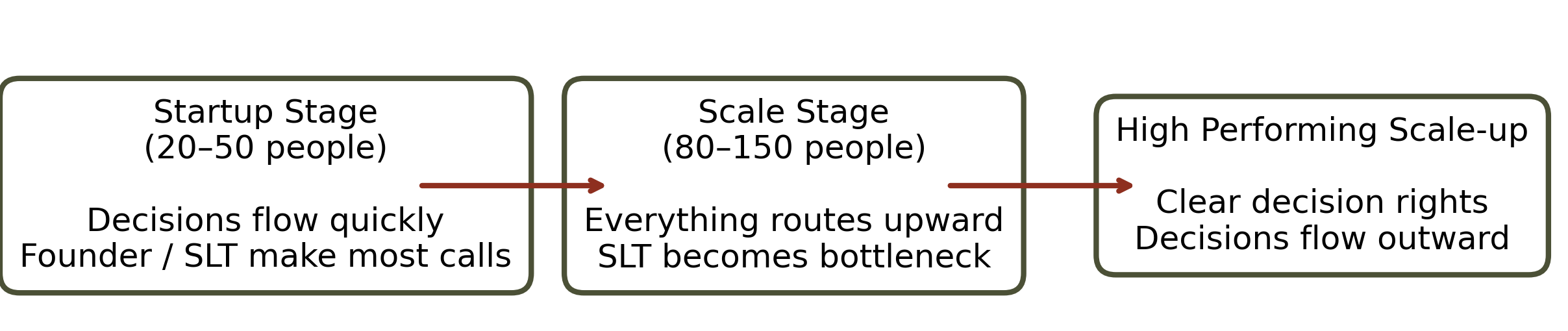
The journey will see you slow down, before you are able to speed up
In all of the above areas it’s a matter of being deliberate about your approach to growth and scaling. These things are not always easy. They require deep and deliberate conversations which will inevitably make some of the senior team feel uncomfortable. Even when you create the systems and frameworks, they take discipline to enable.
Instead of redesigning how the organisation works, I often see CEOs do something else.
They move the org chart around, they hire someone new to ‘fix the problem'.
Or worse, they try to preserve the way things worked when the company was smaller. But the old coaching adage of what got you here won’t get you there.
The organisations that truly scale don’t try to preserve how things worked when they were smaller.
They redesign how the organisation works. They design how it communicates, how it makes decisions and how leaders operate.
Growth doesn’t slow companies down. Unmanaged complexity does.