I was reading through the latest ONS data and the UK labour market figures tell a fairly clear story.
The jobs market hasn’t collapsed, but businesses are becoming more cautious. UK vacancies fell to 707,000 between May and July 2026, down 0.8% on the previous quarter and 2.7% compared with the same period last year.
The shift is particularly visible among smaller businesses. Vacancies fell across the three smallest employer-size categories, with the largest reduction among businesses employing between one and nine people. This is something I’ve felt in the work I’ve been doing. Small and ambitious organisations are keen to grow, but nervous about adding new people.
This matters because SMEs are often the first to feel changes in the commercial climate. Adding another £60,000 or £80,000 salary, plus on costs isn’t just a commitment, it feels like a gamble.
Whilst there are now 2.5 unemployed people for every vacancy, it doesn’t mean the marketplace is favourable for the employer. There are many more entry level candidates and the race for top level talent in emergent technologies is harder than ever. SMEs can rarely compete on salary with the big players. With the cost of living affecting everyone, salary has become more central to employees’ decisions about where to work, demonstrated with consistent wage growth in what should be an employer’s market.
Businesses are therefore finding themselves in a difficult position: they need to grow, improve delivery and make better decisions, but they are understandably reluctant to keep adding permanent cost.
The natural question becomes:
How do we do more with what we already have?
The constraint might not be headcount
When organisations become stretched, the instinct is often to recruit.
Customer onboarding is slow, so hire another onboarding manager. Leaders are overloaded, so add another senior position. Delivery is inconsistent, so bring in a project manager. The people team is struggling, so recruit an HR Director.
Sometimes that is absolutely the right answer. Often, however, the problem isn’t that the organisation lacks another pair of hands. It is that work has become unnecessarily difficult to deliver. Having someone with deep expertise to look at the things that are slowing the organisation down. To look at the systems, operating models and ways of working to identify where things get stuck.
Responsibilities overlap. Decisions sit with too few people. Meetings multiply without producing clarity. Senior leaders become involved in work that should happen elsewhere. Teams solve the same problems independently. Priorities change faster than people can deliver them. Often, when you’re in it, it’s almost impossible to see.
Good people end up working incredibly hard while the organisation continues to move slowly.
That is organisational friction. This is exactly the space in which I work most closely and see most often.
It is rarely captured neatly on a balance sheet, but it shows up everywhere: missed deadlines, slow decisions, leadership exhaustion, duplicated activity, frustrated customers and talented people who eventually decide they’ve had enough.
Recruiting into that environment can add capacity, but it can also add another person into the same confused system. Organisational complexity grows faster than headcount.
A fun little piece that proves this point is a formula used by the Project Management Institute. C = n * (n - 1) / 2 where n is the number of people and C is the number of channels. There’s a neat little calculator here. But if you map it out in a graph it looks like this:
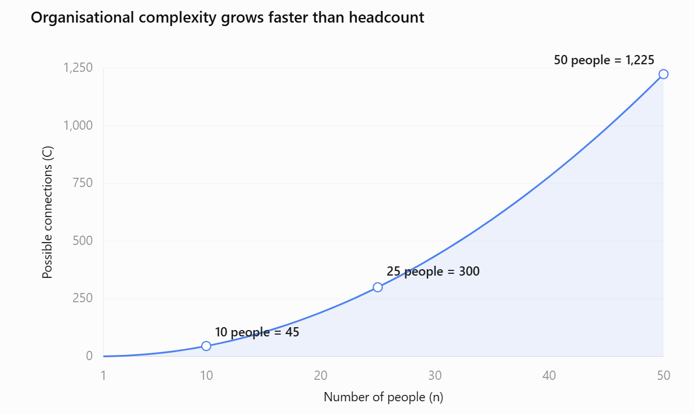
10 people = 45 channels of communication, versus 50 people = 1,225 channels of communication
Unless the underlying operating model changes, headcount can actually increase the friction it was intended to solve. Communication, decision rights, operating systems that allow you to remain agile but effective.
Before approving another senior hire, organisations should ask a more fundamental question:
Do we genuinely need more capacity, or does the work need to operate differently?
Expertise doesn’t always need to become permanent overhead
There is another assumption businesses frequently make: if they need senior expertise, they need to employ it full-time.
That isn’t always commercially sensible.
A growing company may need experienced support to redesign its structure, clarify leadership accountabilities, manage a complex change or build a more effective people function. But it may not need that capability five days a week.
It might need it intensively for six weeks, it might need one day a week for six months….it might need someone to diagnose the problem, design the response and leave the internal team capable of running it. That is where external or fractional people expertise can be particularly valuable.
Done properly, it isn’t an outsourced HR service quietly creating a permanent dependency. Nor is it a consultant arriving with a generic model, producing an impressive deck and disappearing before anything changes.
It is the targeted use of senior capability at the point where it creates the most value.
For an SME, this can provide access to organisational design, transformation and leadership expertise without immediately adding another permanent leadership salary. It also allows the business to define the outcome it needs before deciding what capability should exist internally over the longer term.
The value is not simply having an experienced person in the room. It is creating movement around a problem the organisation has been unable to resolve by itself.
Assess. Fix. Embed.
This is the approach I’ve been taking with my clients at Teaming.
Assess means understanding what is really getting in the way. We look at how work moves through the organisation, where decisions sit, how leadership capacity is being used, where accountabilities overlap and which problems are genuinely caused by insufficient resource.
Fix means making practical changes. That could involve redesigning roles, simplifying decision-making, reshaping a leadership team, improving workflow, rebuilding priorities or targeting investment towards the few capabilities that will genuinely unlock growth.
Embed means ensuring the organisation can sustain the change without relying on us. Leaders need to understand the new expectations, teams need usable ways of working and the business needs simple measures that show whether the changes are actually improving performance.
The engagement usually then ends, leaving long-lasting, embedded change.
For businesses, that creates a relatively low-risk way to access senior people and organisational expertise. There is a defined problem, a focused period of support and a clear transfer of ownership back into the company.
Sometimes the assessment will confirm that another hire is needed. If it does, the business will be much clearer about the role, the outcomes it must deliver and how it fits into the wider organisation.
But sometimes the answer isn’t another person.
Sometimes the quickest route to growth is removing the friction that is stopping the people already there from doing their best work. If all of this sounds familiar, where is the friction sitting in your organisation right now?
Sources: ONS vacancies and jobs, August 2026 and ONS average weekly earnings, August 2026.